

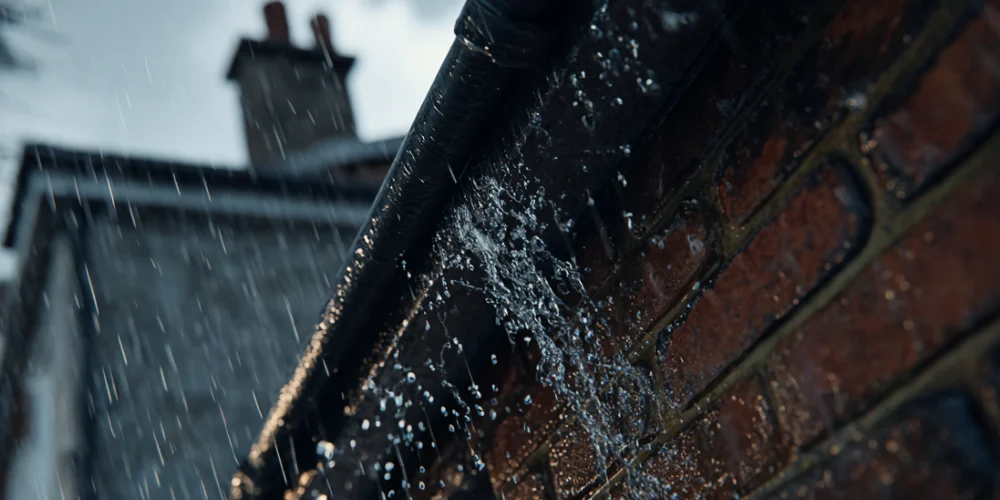
A leaking gutter rarely feels urgent. A drip here, a bit of staining there, nothing that seems worth immediate attention. Yet time and again, serious structural issues can be traced back to a single, overlooked gutter defect.
In Cheltenham and across the Cotswolds, many properties are older, traditionally built, and far less forgiving when water is allowed to go where it shouldn’t. What begins as a minor gutter overflow can quietly trigger a chain reaction that affects walls, timbers, internal finishes, and, in extreme cases, the foundations themselves.
This article follows the real journey of a gutter leak, from the first overflow to the point at which subsidence becomes a genuine risk, and explains why early gutter repairs are among the most important forms of preventive property maintenance.
The First Stage: A Gutter That No Longer Drains Properly
How Small Gutter Defects Begin
Most serious gutter-related damage starts with something simple. A small blockage from moss, leaves, or roof debris is often the trigger. In Cheltenham, tree-lined streets and moss-prone roofs make this particularly common.
Alternatively, the problem may begin with:
- A failed joint seal
- A loose bracket is causing slight sagging
- A cracked section of the gutter
- A downpipe is partially blocked at the roof level
At this stage, the gutter still appears to work most of the time, especially during light rainfall. This false sense of security is what allows the issue to persist.
Why Overflow Is Often Missed
Gutter overflow typically occurs during heavy rain, when the volume of water exceeds the system’s reduced capacity. If no one is outside at the time, the problem goes unnoticed.
Because the overflow often runs down the same section of wall repeatedly, the damage it causes is concentrated and progressive.
Stage Two: Repeated Water Exposure to External Walls
Saturation of Brickwork and Stone
Once a gutter overflows regularly, water begins to seep into the exterior wall below. Traditional brickwork and Cotswold stone are inherently porous, designed to manage moisture through breathability rather than by being impermeable.
When these materials are repeatedly soaked, they retain moisture far longer than intended.
Mortar Joint Deterioration
Water affects more than the surface. It penetrates mortar joints, weakening them over time. Lime-based mortars, common in older Cheltenham properties, are especially vulnerable to prolonged saturation.
As mortar erodes, gaps form, allowing even more water into the wall structure.
Stage Three: Damage to Fascias, Soffits, and Roofline Timbers
The Vulnerability of Roofline Components
Gutters are fixed directly to fascia boards, making roofline timbers one of the first casualties of prolonged overflow.
Repeated wetting leads to:
- Paint breakdown
- Timber swelling and splitting
- Early stages of rot
Once rot sets in, fixings loosen, allowing the gutter to sag further and worsening the original problem.
How One Issue Accelerates Another
This is where gutter leaks become self-reinforcing. A leaking gutter damages the fascia. A weakened fascia allows the gutter to move. Movement causes more leaks and overflow.
Without intervention, deterioration accelerates rapidly.
Stage Four: Water Penetration Into the Property
How Moisture Travels Inwards
Water running down external walls does not stay outside indefinitely. Over time, it penetrates through mortar joints, hairline cracks, and porous masonry.
In solid-wall properties, common throughout Cheltenham, there is no cavity to interrupt this process. Moisture transfers directly from the external wall to the internal plaster.
Early Internal Warning Signs
At this stage, homeowners may begin to notice:
- Damp patches on internal walls
- Peeling paint or wallpaper
- Musty smells near external walls
- Cold, clammy surfaces
These symptoms are often treated cosmetically, masking the underlying cause.
Stage Five: Internal Damp, Mould, and Timber Decay
The Cost of Persistent Moisture
Once moisture enters the building fabric, secondary problems develop quickly. Damp internal walls create ideal conditions for mould growth, which affects indoor air quality and occupant health.
In roof spaces, moisture leads to:
- Damp insulation with reduced thermal performance
- Increased heating costs
- Condensation on timbers
Roof timbers exposed to repeated moisture begin to decay, compromising structural integrity from within.
Stage Six: Ground Saturation Around the Property
Where the Water Really Goes
Not all overflowing gutter water runs down walls. Much of it lands at ground level, directly beside the building.
Over time, this results in persistent soil saturation around the property. In areas with clay-rich ground, common across parts of the Cotswolds, water drains slowly and remains in contact with foundations for extended periods.
Why This Matters More Than Many Realise
Foundations are designed to bear load through stable ground conditions. When soil becomes repeatedly saturated, its load-bearing characteristics change.
This creates uneven pressure on foundations — the starting point for movement.
Stage Seven: Foundation Movement and Structural Stress
From Settlement to Structural Concern
Not all movement is dramatic, but even small shifts can have visible consequences.
Common signs include:
- Cracks are forming above doors and windows
- Stair-step cracking in brickwork
- Uneven internal floors
- Doors and windows are sticking
While subsidence is not common, prolonged poor drainage caused by faulty gutters is a recognised contributing factor.
Why Gutter Leaks Are Often Overlooked as a Cause
When subsidence or structural movement is suspected, attention often turns to drainage, trees, or ground conditions. Guttering is often overlooked, even though it is the primary source of excess water.
By the time movement becomes noticeable, the gutter issue may have existed for years.
Why Cheltenham Properties Are Particularly at Risk
Older Buildings and Traditional Construction
Cheltenham’s housing stock includes a high proportion of period properties, Regency terraces, and older family homes. These buildings were constructed with breathable materials and shallow foundations by modern standards.
They perform well when water is managed correctly, but poorly when exposed to prolonged saturation.
Environmental Factors
Tree-lined streets, regular rainfall, and moss-prone roofs all increase the likelihood of gutter blockages. Without regular inspection and repair, the risk of long-term water damage increases significantly.
The Financial Reality: Small Repair vs Major Remedial Work
The Cost Difference Is Stark
A minor gutter repair or clean typically costs a few hundred pounds at most. Compare that with:
- Damp treatment and replastering
- Timber repairs
- Structural investigations
- Foundation stabilisation
The financial gap between early intervention and late repair is substantial.
Why Preventive Maintenance Always Wins
Gutter maintenance is one of the highest return-on-investment tasks a homeowner can undertake. Preventing water from entering the structure protects all other building elements.
How Gutter Repairs Break the Chain Early
What Effective Gutter Repairs Achieve
Proper gutter repairs restore:
- Correct water flow
- Secure fixings and alignment
- Watertight joints
- Effective discharge away from the property
This immediately halts the cascade of damage before it worsens.
The Value of Professional Inspection
Many gutter defects are not visible from ground level. Professional inspections, including drone surveys where appropriate, accurately and safely identify early issues.
When Homeowners Should Act
Situations That Demand Attention
Gutter repairs should be prioritised if:
- Gutters overflow during rainfall
- Staining appears on the external walls
- Damp patches develop internally
- The property has not been inspected in several years
- There are trees close to the roofline
Early action prevents escalation.
One Drip Can Change Everything
Subsidence rarely starts with a dramatic event. More often, it begins with something mundane: a blocked gutter, a leaking joint, a slow overflow left unaddressed for too long.
Understanding the long journey of a gutter leak makes one thing clear: gutters are not minor accessories. They are a frontline defence against water damage and structural failure.
For Cheltenham homeowners, proactive gutter repairs are not just maintenance. They are protection for the entire property.
Related Articles
- Gutters vs Clay Soil: How Poor Drainage Affects Foundations in the Cotswolds
- How Small Gutter Issues Turn Into Big Structural Problems
- The Ultimate Seasonal Gutter Repair Checklist
The long-term consequences of a gutter leak can be far more expensive than the repair itself. Browse our guttering services for inspections, repairs, and replacements. Investing in preventive roof maintenance alongside gutter upkeep is the best way to protect your property from water damage. Read what our customers say.
For the full picture, see the full guide to guttering in Cheltenham.