

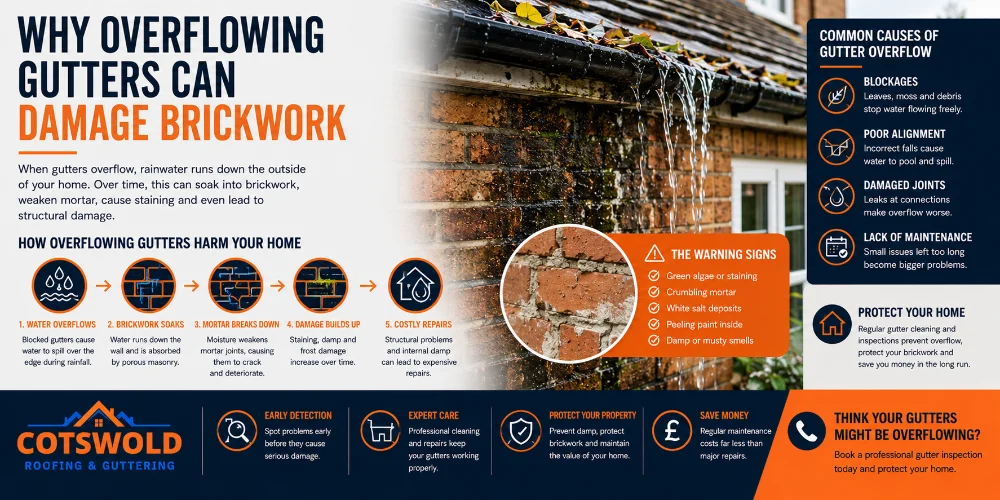
Overflowing gutters are often dismissed as a minor maintenance issue.
Many homeowners assume that if rainwater is flowing outside the property rather than inside, there is little reason for concern.
Unfortunately, that assumption can become expensive.
Repeated gutter overflow exposes brickwork to far more water than it was designed to manage. Over time, this can lead to staining, damp, frost damage, mortar deterioration and, in some cases, structural problems.
This guide explains why overflowing gutters damage brickwork, what warning signs to look for and how homeowners can protect their property.
Why Brickwork Absorbs Water
Brick may appear solid, but it is naturally porous.
Bricks and mortar absorb small amounts of moisture during normal weather conditions and then release that moisture through evaporation.
Problems begin when brickwork experiences repeated saturation.
Overflowing gutters expose the same areas continuously, preventing the wall from drying properly.
Over time, this increases the risk of long-term deterioration.
What Causes Gutters to Overflow
Overflow rarely happens without an underlying issue.
Common causes include:
Blockages
Leaves, moss and debris prevent water from flowing freely.
Incorrect Alignment
Poor falls allow water to collect instead of draining.
Undersized Systems
Some older systems struggle during periods of heavy rainfall.
Damaged Joints
Leaks at connections increase localised water exposure.
Poor Maintenance
Small defects often become larger drainage problems.
For broader guidance, see:
Common Gutter Problems and How to Avoid Them
How Overflowing Gutters Damage Brickwork
Water damage usually develops gradually.
Saturation of Masonry
Persistent overflow allows water to soak into brick faces.
Mortar Breakdown
Mortar joints often deteriorate faster than bricks.
Once joints weaken, additional moisture enters the wall.
Surface Staining
Dark patches and algae frequently develop beneath overflow areas.
Frost Expansion
During colder weather, trapped moisture expands and increases damage.
Internal Damp
Water may eventually pass through the wall structure.
If damp is already appearing internally, read:
Can Blocked Gutters Cause Internal Damp?
Why Older Cheltenham Properties Need Extra Attention
Cheltenham contains many period properties built using traditional materials.
Older masonry can behave differently from modern construction.
Particular risk factors include:
- Lime mortar construction
- Regency façades
- Concealed drainage systems
- Decorative masonry details
These buildings often require earlier intervention because moisture movement can affect larger areas.
Overflow problems should never be ignored on heritage buildings.
Can Overflowing Gutters Affect Foundations?
In some situations, yes.
Large volumes of repeated runoff may:
- Saturate the surrounding ground
- Affect drainage behaviour
- Increase movement risk
This is particularly relevant in areas with clay soils.
Water management protects more than the visible walls.
Early Signs of Brickwork Water Damage
Watch for:
External Signs
- Green staining
- White salt deposits
- Crumbling mortar
- Dark damp areas
Internal Signs
- Peeling paint
- Damp smells
- Staining
- Mould
Early identification reduces repair costs.
How to Prevent Gutter Overflow
Preventive maintenance is usually straightforward.
Regular Cleaning
Keep gutters free from debris.
Seasonal Inspections
Autumn and winter checks are particularly important.
Prompt Repairs
Do not ignore minor leaks.
Professional Assessment
Identify hidden defects before they escalate.
For practical maintenance advice, read:
How to Maintain Your Gutters and Prevent Costly Repairs
Why Professional Inspection Makes Sense
Many overflow causes cannot be seen from ground level.
Professional inspections help identify:
- Hidden blockages
- Alignment issues
- Internal failures
- Early structural concerns
This allows targeted repairs rather than reacting to visible damage later.
Safety First
Gutter inspection involves working at height.
The Health and Safety Executive identifies roof and ladder work as high risk.
Inspection should remain at ground level unless carried out by trained professionals.
What Should Homeowners Do Next?
Overflowing gutters are rarely just a cosmetic issue.
Small drainage failures often become larger repair projects if ignored.
If you notice overflow during rainfall, visible staining or damp beneath roof edges, it is worth arranging an inspection before more extensive damage develops.
Protecting brickwork early is almost always simpler and less expensive than repairing water damage later.