

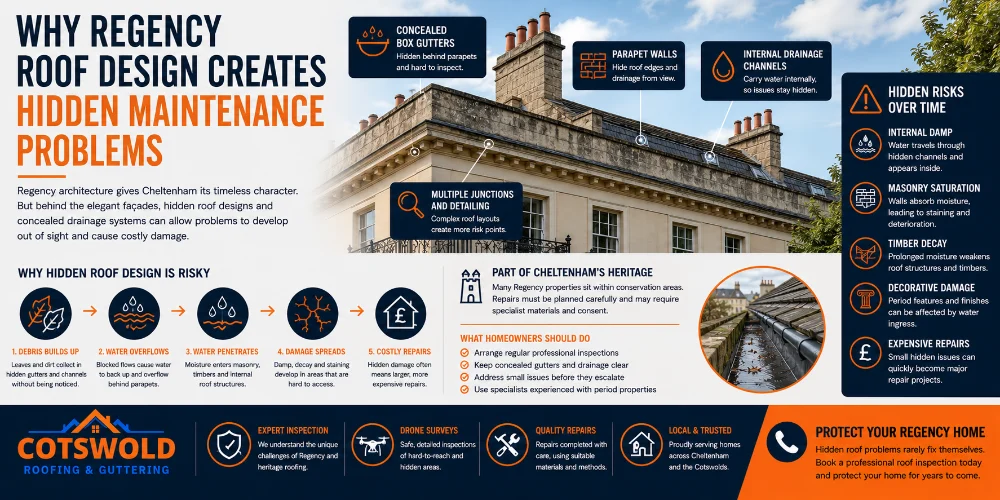
Regency architecture remains one of Cheltenham’s defining features.
The elegant façades, clean rooflines and decorative detailing create some of the town’s most recognisable properties. However, behind those attractive exteriors sits a roofing design that often creates hidden maintenance challenges.
Unlike modern roofing systems, Regency roofs were frequently designed to conceal drainage and reduce the visual impact of the roofline from street level.
While visually impressive, these designs can allow problems to develop unnoticed.
This guide explains why Regency roofs behave differently, where hidden issues commonly develop and what homeowners should understand before problems become expensive repairs.
What Makes Regency Roof Design Different?
Regency properties were designed with appearance as a priority.
Rather than exposing roof structures and gutters, many buildings were designed with architectural features that create a cleaner frontage.
Common characteristics include:
- Parapet walls
- Concealed box gutters
- Internal drainage channels
- Multiple roof junctions
- Decorative masonry details
- Hidden roof edges
Although attractive, these features reduce visibility and make inspection more difficult.
Why Hidden Roof Design Creates Maintenance Challenges
Modern roofs often show visible warning signs early.
Regency roofs frequently do not.
Because many components are concealed, defects may remain unnoticed for long periods.
Water can travel behind walls and drainage channels before becoming visible internally.
This means damage is often more advanced by the time symptoms appear.
Concealed Gutters Are One of the Biggest Risks
One of the most common issues in Regency properties is concealed gutter failure.
Unlike standard external gutters, concealed systems sit behind parapets and carry water internally.
Common problems include:
Blockages
Leaves and debris collect out of sight.
Overflow
Water backs up internally rather than externally.
Failed Linings
Protective materials deteriorate over time.
Hidden Leaks
Water enters the structure before becoming visible.
This is one reason older Cheltenham properties benefit from proactive inspection.
If you want to understand concealed drainage further, read:
The Difference Between Box Gutters, Valley Gutters and Standard Gutters
Why Roof Leaks in Regency Properties Are Difficult to Trace
Water rarely appears directly below the source.
Once water enters a Regency roof system, it often follows:
- Timber structures
- Internal drainage routes
- Ceiling voids
- Masonry cavities
Visible damp frequently appears far from the actual defect.
This makes diagnosis particularly important.
You may also find useful:
Why Roof Leaks Often Appear Far Away From the Actual Damage
Why Maintenance Delays Become Expensive
Many homeowners delay maintenance because there are no obvious signs.
Unfortunately, hidden roof systems often continue deteriorating.
Potential consequences include:
Internal Damp
Moisture penetrates ceilings and walls.
Masonry Saturation
Brick and stone absorb prolonged moisture.
Timber Decay
Structural elements weaken over time.
Decorative Damage
Period features may require specialist restoration.
Cheltenham Conservation Areas Add Complexity
Cheltenham includes numerous conservation areas containing Regency buildings.
Maintenance and repairs often require more careful planning than modern properties.
Changes to visible roof elements may require consideration under local conservation controls.
Listed buildings may also require formal consent before certain works proceed.
This does not prevent maintenance, but it does mean repairs should be approached correctly.
Why Professional Inspection Matters More on Regency Roofs
Visual checks from ground level rarely provide enough information.
Professional inspections allow contractors to assess:
- Hidden drainage systems
- Roof junctions
- Chimney condition
- Concealed gutters
- Early moisture ingress
In many cases, detailed inspection prevents larger repair projects later.
When Roof Surveys Become Valuable
Some roof systems cannot be assessed properly without specialist methods.
Roof surveys become particularly valuable when:
- Buying older properties
- Investigating internal damp
- Planning repairs
- Assessing maintenance requirements
Older roof systems benefit from understanding before work begins.
Why Preventive Maintenance Works Best
Regency roofs generally respond better to planned maintenance than reactive repairs.
Good practice includes:
Annual Inspections
Identify problems early.
Seasonal Drainage Checks
Prevent concealed blockages.
Prompt Repairs
Small defects should not be left.
Professional Cleaning
Remove debris safely.
Preventative care helps preserve both the roof and the building beneath it.
Safety First
Roof work should never be attempted without suitable equipment and training.
The Health and Safety Executive identifies roof access and working at height as high-risk activities.
Regency properties often introduce additional hazards because drainage and roof edges may be concealed.
Professional inspection remains the safest approach.
What Should Homeowners Do Next?
Regency properties remain some of Cheltenham’s most attractive homes.
However, their hidden design means maintenance needs to be approached differently.
If your property includes parapets, concealed gutters or signs of internal moisture, early inspection can prevent significant long-term damage.
Understanding how these roofs work is often the difference between simple maintenance and major repairs later.